Delve into the idea of a proposed Welsh peace gong, inspired by the Mabinogi and the Deiseb Heddwch, the Welsh Women’s Peace Petition from 1923–24. This initiative combines storytelling, artistry, and a dedication to peace within the public sphere.
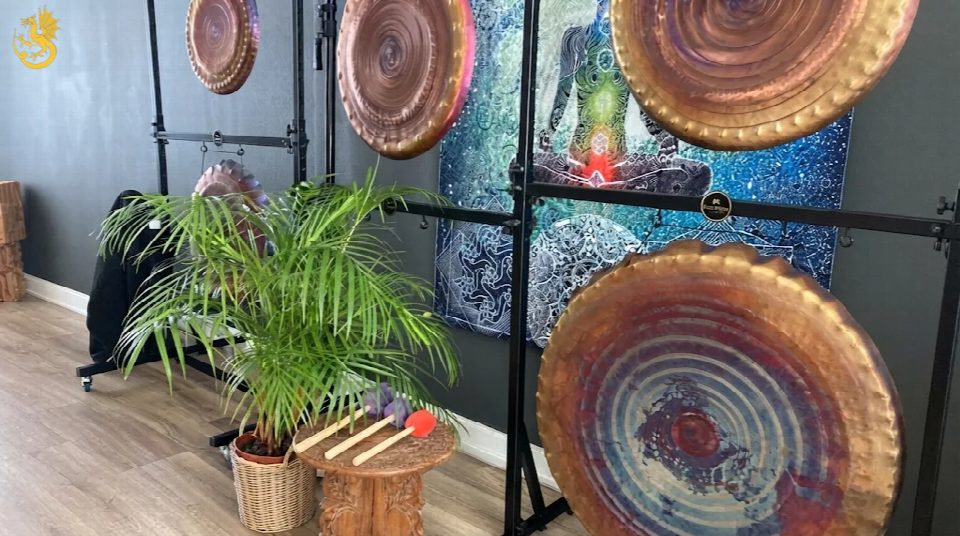
Exploring the Mabinogi and Its Connection to the Deiseb Heddwch Peace Initiative
Investigating the Harmony of Stone and Metal in Welsh Cultural Heritage
History reverberates through various mediums. It is woven into the grain of wood, the layers of Welsh slate, and the resonant sounds of finely crafted metalwork.
For Sarah Ward and her partner Ashley, this resonance signals the start of an innovative project: a Welsh peace gong, adorned with designs inspired by the Mabinogi, aimed at public marches and community gatherings.
Through their endeavours at Awen Sounds, they seek to merge storytelling and artisanal craftsmanship with the rich legacy of the Welsh Women’s Peace Petition of 1923–24, known as the Deiseb Heddwch.
These legacies capture unique yet intertwined histories. The Mabinogi presents narratives of kindness, conflict, sorrow, and the exertion of power.
In contrast, the petition recounts the efforts of women advocating for an international call for peace. The gong aspires to draw from both heritages while acknowledging that medieval tales and modern activism may not always align seamlessly.
This gong embodies both practical and symbolic dimensions: it is a portable object that invites gathering and listening. Its engraved imagery encourages visual engagement, while its sound serves as a moment of contemplation during events.
The familial connections add a unique layer of meaning to this proposal within House of Rhodri. Sarah is the author’s niece and plays a pivotal role in the family narrative driving the project.
Her involvement links the preservation of family history with a vibrant creative response to the stories and commitments that have been passed down through generations.
Linking the Mabinogi: Perspectives from the Four Branches in Relation to Peace
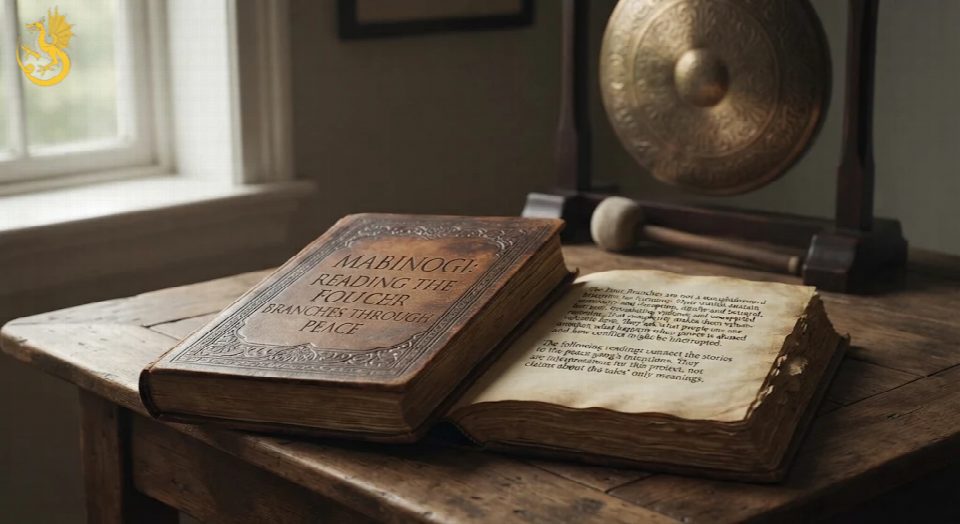
The Four Branches do not offer a simple formula for peace. Their narratives intertwine themes of generosity and betrayal, loyalty and treachery, profound violence, and surprising restraint. This complexity enhances their relevance in today’s context.
They invite reflection on our responsibilities to one another, the repercussions of wielding power irresponsibly, and the potential paths to conflict resolution.
Subsequent interpretations connect these narratives to the motivations behind the peace gong. These readings provide insights for the project rather than definitive understandings of the stories.
Branch One: Pwyll, Prince of Dyfed
A pivotal moment in the First Branch begins with an unfulfilled chase. Pwyll sees Rhiannon riding past, yet neither he nor his companions can catch up to her. Despite their earnest efforts, they remain out of reach.
Eventually, Pwyll calls out, asking her to stop. She consents.
This encounter illustrates a significant shift: a connection is established when pursuit transforms into a respectful request for interaction.
Pwyll does not require a swifter horse; he needs to foster dialogue, and Rhiannon must choose to engage.
While the broader tale includes elements of violence and manipulation, this moment demonstrates how civility can achieve what aggression struggles to attain.
This insight reflects on the proposed gong: peace may rely not only on personal resolve but also on one’s approach to others.
Branch Two: Branwen, Daughter of Llyr
The Second Branch discusses the devastating aftermath of conflict between Britain and Ireland. Insults and mistreatment escalate into destruction, leaving only a small number of survivors.
Branwen’s narrative humanises the impact of warfare: the losses are experienced by individuals bound by relationships that transcend the divisions around which violence erupts.
After the conflict, the remaining companions spend seven years feasting at Harlech, listening to the birds of Rhiannon.
In other tales from the Mabinogion, especially within Culhwch and Olwen, these birds possess the ability to awaken the dead and comfort the living.
In the context of the peace gong, these birds symbolise a sound that transforms the listener’s experience. Their song evokes remembrance, comfort, and the ability to focus on issues beyond the immediate conflicts.
This perspective does not diminish the sorrow inherent in the branch. The birds cannot restore what has been lost.
Their presence in the aftermath allows both restoration and loss to coexist, rather than suggesting a simplistic notion that harmony resolves all.
Branch Three: Manawydan, Son of Llyr
Manawydan’s tale highlights the importance of craftsmanship. Confronted with a cursed and desolate land, he turns to trade and creation.
When his success breeds hostility, he consistently opts for progress over violence with Pryderi.
His patience mirrors the gong’s purpose. Skill nurtures continuity, while self-restraint prevents a dispute from escalating into further violence.
Craftsmanship alone does not break the enchantment. Manawydan gains leverage by threatening to hang a captured mouse, revealed to be the enchanter’s wife.
This tactic secures the release of his companions and lifts the curse over Dyfed.
This narrative does not offer a straightforward moral of peaceful persuasion. Its resolution is complex, involving pressures, demands, and careful negotiations.
The significance of this complexity lies in understanding that conflict resolution may require more than goodwill, and the conditions surrounding a resolution deserve as much scrutiny as the desire to achieve one.
Branch Four: Math, Son of Mathonwy
The Fourth Branch vividly depicts the misuse of power. Its betrayals and transformations prompt essential questions about treating individuals as mere tools of another’s will.
For Sarah and Ashley’s initiative, the transformations involving Blodeuwedd and Lleu Llaw Gyffes encourage reflection on humanity’s relationship with the natural world.
Human aspirations are pursued through bodies, creatures, and materials that become entangled in the struggle for dominance.
This ecological interpretation resonates with this contemporary endeavour rather than serving as a definitive message from the tale. It raises questions about responsibility when the consequences of one’s actions extend beyond the individual making the choice.
Collectively, the Four Branches provide the gong with a visual language that encompasses both hope and discomfort. Their importance lies not in depicting peace as simple, but in illustrating why it is a challenging journey.
Celebrating the Legacy of the Deiseb Heddwch
While the Mabinogi provides narratives for reflection, the Welsh Women’s Peace Petition represents a structured movement for change.
In 1923, women across Wales gathered an impressive 390,296 signatures for a plea directed at the women of the United States.
Their request was both ambitious and specific: they urged American women to advocate for their government to join the League of Nations and promote international cooperation as a viable alternative to warfare.
In 1924, Annie Hughes-Griffiths, Mary Ellis, Elined Prys, and Gladys Thomas transported the petition to America, its signatures stored in an oak chest.
The chest symbolised a collective appeal. Each signature belonged to an individual, yet together they formed a significant request that could traverse the ocean and be presented to others.
For our family, the Deiseb Heddwch also holds a direct personal connection. Among its signatories were Sarah Davies of Glasgoed, Rhydlewis, and her youngest daughter, Greta (Margretta) Davies, who signed directly beneath her mother.
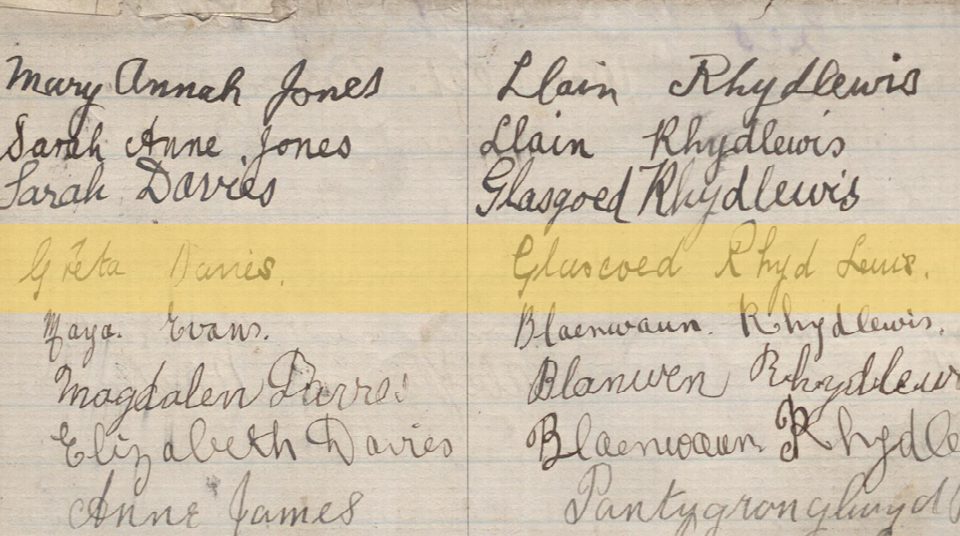
Their signatures link two generations of our family to this broader movement for peace, bringing the history of the petition closer to our personal narrative.
Remembering Aunty Getta
In our family history, Greta (Margretta), the youngest daughter, is affectionately known as Aunty Getta. Gillian fondly recalls visiting her at Glasgoed during childhood:
“We used to go and see her when we were little. Aunty Getta. I remember quite a bit about those visits. Lynne and I were a bit cheeky and would take her blue tablets, which she used for whitening clothes, and swish them in the stream beside the house, wasting them!”
The proposed gong is inspired by the interplay between conviction and public action. It does not aim to replicate the petition or claim to represent every woman who endorsed it.
Instead, it seeks to honour their efforts by creating a new focal point around which people can unite and express their own commitment to peace.
Forging Sheet Metal into a Public Sound Symbol
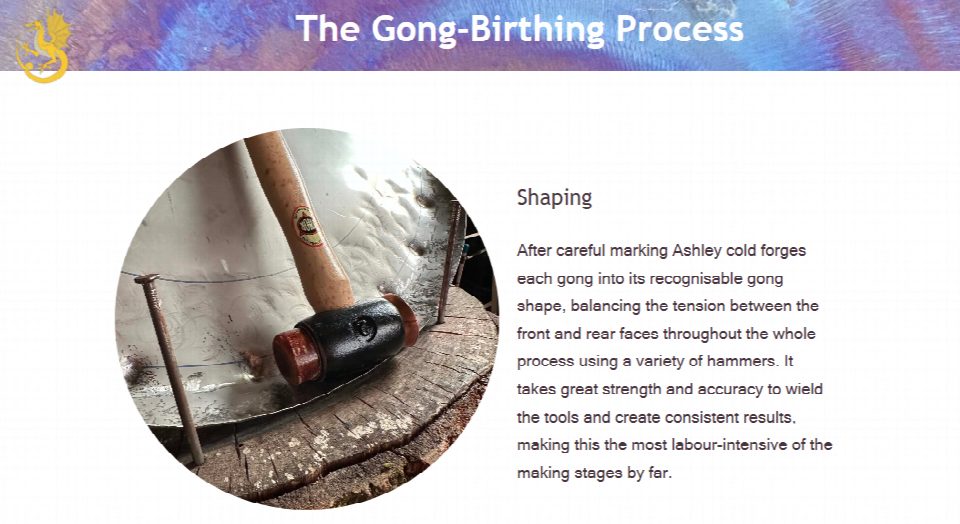
At Awen Sounds, the creation process begins with sheet metal, which is hand-forged into a distinctive instrument. Each strike shapes its form and influences its tone. The surface is then etched and fired outdoors to achieve its unique colouration.
For the envisioned peace gong, this process merges imagery and sound into a cohesive object. The stories do not remain confined to written text; their representations can resonate in public spaces, squares, and community gatherings.
A gong serves as a focal point for assemblies. Its sound can signal a commencement, accompany public declarations, or invite moments of silence.
Responses may vary, yet all participants receive the same invitation to pause and reflect.
This initiative is a modern interpretation, not a revival of an ancient Welsh ceremony.
Its connections to history emerge through the chosen stories, the remembered petition, and the intentions of those who create and carry it.
A New Instrument for an Ongoing Journey
Sarah and Ashley’s proposal revitalises ancient stories for a purpose that remains critically relevant. Courtesy does not resolve every conflict.
Restraint does not erase all injustices. Even a meticulously negotiated settlement cannot undo the past.
The gong’s significance lies not in the promise of resolution.
Its connection to the Mabinogi is cultural and literary, rather than a claim of lineage from legendary figures.
Its relationship with the petition represents an act of remembrance and response, not an assertion of authority to speak for the women who endorsed it.
When struck, it will not proclaim that peace has been achieved. Instead, it will invite those present to listen and contemplate their future actions.
References and Suggested Reading
This article synthesises literary and historical sources alongside insights into a contemporary creative initiative.
The interpretations of the Mabinogi, through themes of peace, responsibility, and humanity’s connection with the natural world, serve as insights for this project rather than claims about the stories’ exclusive or original meanings.
The Mabinogi and the Broader Mabinogion
- The Mabinogion, translated by Lady Charlotte Guest: Project Gutenberg. A freely accessible historical English translation that includes the Four Branches and Culhwch and Olwen, referred to as Kilhwch and Olwen.
Relevant excerpts can be found in “Pwyll Prince of Dyved”, “Branwen the Daughter of Llyr”, “Manawyddan the Son of Llyr”, “Math the Son of Mathonwy” and “Kilhwch and Olwen”. Variations in spelling and wording exist across translations.
- Manawydan fab Llyr: The Third Branch of the Mabinogi, Mabinogi.net. An English translation with explanatory notes, including episodes related to saddle-making, shield-making, and shoemaking, as well as the negotiations leading to the release of Rhiannon and Pryderi and the lifting of the enchantment over Dyfed.
The Four Branches of the Mabinogi should be distinguished from the broader collection commonly referred to as the Mabinogion.
The birds of Rhiannon feature in the Second Branch, while the explicit description of their ability to awaken the dead and soothe the living appears in Culhwch and Olwen.
The Welsh Women’s Peace Petition
-
The Welsh Women’s Peace Petition: National Library of Wales. Historical context regarding the petition, which gathered 390,296 signatures, the oak chest, and the delegation of Annie Hughes-Griffiths, Mary Ellis, Elined Prys, and Gladys Thomas.
-
The Welsh Women’s Peace Petition: Search the Signatories. The National Library of Wales’s dedicated platform to explore the petition and its signatories.
-
“Inspired by Annie”: The Story of the 1923 Welsh Women’s Peace Petition to America, Welsh Centre for International Affairs. Additional context on the campaign, its organisation, and its aspirations for international peace.
Modern Craft and Family Context
- Awen Sounds: Handcrafted Gongs, Made in Wales. An overview of the makers’ practices, detailing gongs cold-forged by hand from sheet metal, etched, and fired outdoors to develop their unique colouration.
This provides insight into their general crafting process, rather than a technical specification for the proposed peace gong.
- House of Rhodri: Welsh Family History. The family-history context from which this article arises. The Mabinogi is utilised as a cultural and literary reference, not as genealogical evidence.
Project Insights
Details regarding the conception, intended imagery, and planned public use of the proposed peace gong were shared with the author by Sarah Ward and her partner, Ashley, via personal communication on 7 November 2026.
Sarah is the author’s niece, a supporter of House of Rhodri, and a documented member of the project’s family lineage.
This relationship provides personal context for the article; the published sources cited above support its literary, historical, and general craft background.
Further family-history material is accessible in the House of Rhodri Archive, available for a modest subscription fee.
The post Welsh Peace Gong: Exploring the Mabinogi and Heddwch appeared first on Limits Of Strategy.