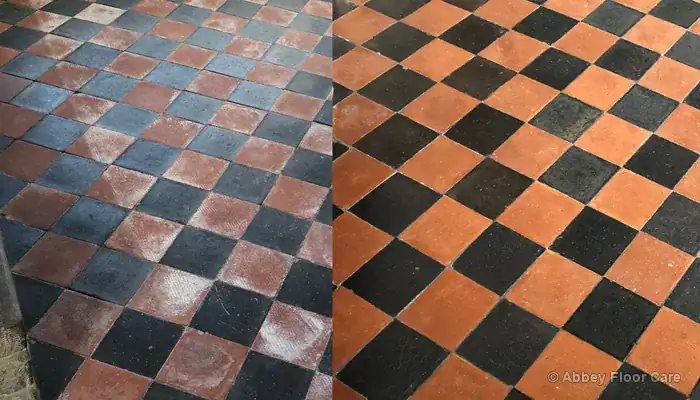
What sets quarry tiles apart from other flooring solutions?
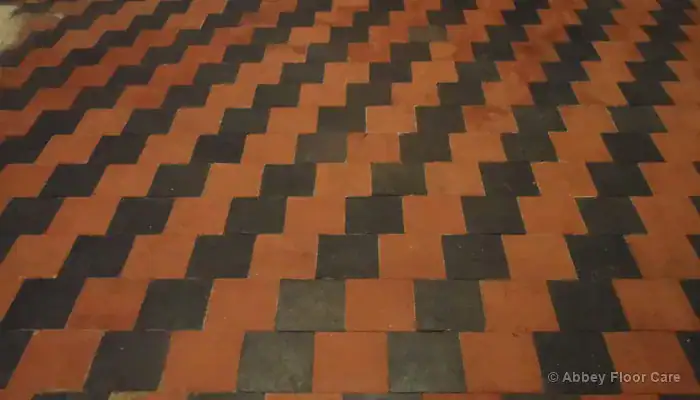
The Importance of Clay Material in Quarry Tiles
Quarry tiles are crafted from dense, unglazed clay, subjected to high-temperature firing. This process yields a robust, moisture-sensitive surface without a protective glaze. Unlike ceramic or porcelain tiles, quarry tiles lack a sealing glaze, exposing their clay body to foot traffic, cleaning agents, and moisture from the beginning. This continuous cycle of moisture absorption and release is fundamental to their design.
The clay body comprises fine mineral particles with voids that allow moisture vapour to pass through. This enables water vapour to rise from the subfloor, travel through the tile, and evaporate at the surface. In many historic properties across the UK, quarry tiles are laid directly on lime or compacted earth, often bypassing a damp-proof membrane, which promotes intentional moisture movement. Sealing this pathway disrupts the intended function of the tile instead of offering protection.
The Effects of the Firing Process on Tile Characteristics
The firing temperature of quarry tiles influences their final density, colour, and porosity. Tiles fired at lower temperatures yield softer, more porous materials that absorb liquids quickly and are typically found in older Victorian and Edwardian homes. In contrast, tiles fired at higher temperatures create denser materials with tighter voids, which provide enhanced resistance to liquid absorption while remaining unglazed and moisture-active. Both types differ fundamentally from glazed or polished flooring options.
This production method ensures that the colour of quarry tiles is inherent to their composition, extending throughout the clay body rather than merely coating the surface. The colour cannot be scrubbed away like a painted finish. Over time, the surface texture may change due to wear, resulting in colour variations as contaminants accumulate within the tile. A floor that appears consistently dark likely harbours ingrained contamination rather than showcasing its original clay hue.
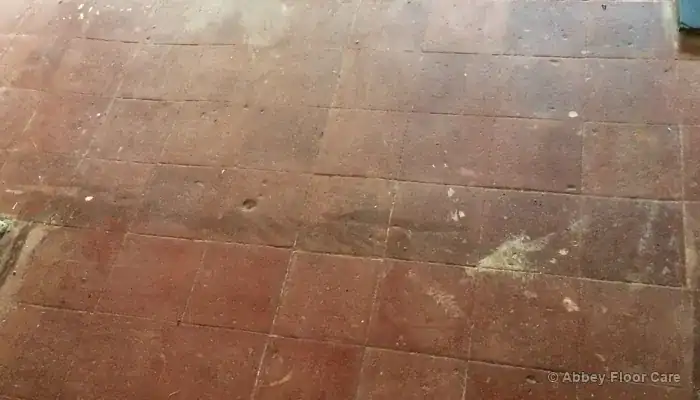
The Consequences of Lacking a Glaze
Glazed tiles feature a glass-like coating that repels liquids, resists stains, and simplifies cleaning by keeping dirt on the surface. Conversely, quarry tiles lack this protective layer; their open clay surface allows liquids to penetrate directly. Grease, cleaning residues, dirt, and water seep into the tile body rather than remaining on the surface. Over time, these substances build up beneath the surface, rendering standard surface cleaning ineffective.
This explains why traditional cleaning methods, which involve applying a product, mopping, and rinsing, consistently result in poor outcomes on quarry tiles. Cleaning solutions typically only address residues on the surface, while deeper layers of contamination persist. A floor that has been cleaned regularly for years may still retain decades’ worth of ingrained contamination since standard cleaning products do not penetrate deeply enough to eliminate it. Recognising the necessity for professional deep cleaning is critical for maintaining these floors properly.
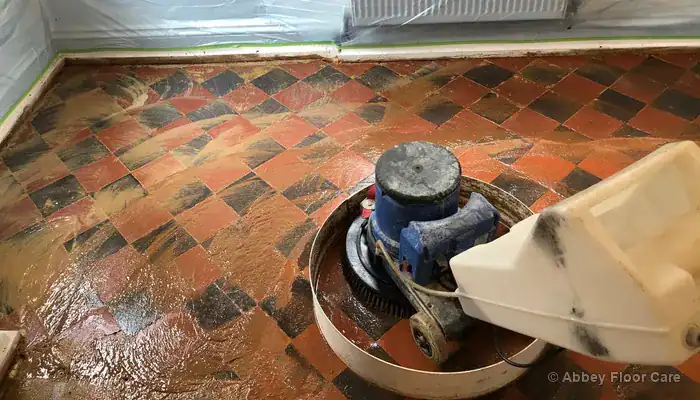
This quarry tile resource offers comprehensive insights on the lifecycle of these floors, covering everything from quarry tile fundamentals to cleaning, restoration, and sealing recommendations for various conditions.
Moisture Vapour Transmission: Importance and Risks of Obstruction
Moisture vapour transmission refers to the ongoing movement of water vapour through the subfloor, tile, and into the living space. When a quarry tile floor functions correctly, this process occurs unnoticed and without damaging the structure. The floor breathes efficiently, maintaining its structural integrity while salts carried by moisture either evaporate harmlessly at the surface or disperse through the open clay structure.
If moisture transmission is obstructed, often due to a film-forming sealer that blocks the tile’s pores, moisture accumulates beneath the surface. This can lead to blistering, peeling, or discolouration. Salts deposited from trapped moisture create white crystalline deposits known as efflorescence. Additional cleaning efforts will not resolve this issue; the core problem lies in the obstructed breathability, necessitating the removal of the coating to restore the tile’s moisture movement.
Identifying Embedded Contamination and Its Build-Up
Embedded contamination consists of grease, soil, organic matter, and residues that have penetrated the clay body over years of use. Unlike recent spills, this contamination is not visible on the surface. It manifests as general darkening, persistent dullness, or a floor that never appears clean despite diligent cleaning efforts. Heavily contaminated floors may feel slightly sticky due to old wax and grease residues trapped in the upper layers of the clay body.
This accumulation occurs gradually and often goes unnoticed. Each meal prepared, every muddy shoe, and every application of cleaning product contributes to a layer of residue absorbed by the tile. Over a decade or two, this build-up leads to contamination that cannot be removed by surface cleaning products. Addressing it requires specialised chemistry that penetrates into the clay body, typically through controlled alkaline cleaning with wet vacuum extraction, targeting the contamination directly rather than merely treating the surface.
Why does your floor appear dirty even after cleaning?
If your quarry tile floor looks dirty after mopping, the contamination has likely penetrated the clay body itself. This situation arises when traditional cleaning methods cease to deliver visible improvements, and continuing to use the same techniques will not change the outcome. The floor isn’t unresponsive because it’s beyond repair; it’s unresponsive because the cleaning efforts are targeting the wrong layer.
Residue cycling occurs when each cleaning session disturbs surface contamination without effectively removing the embedded layer. The floor may appear cleaner immediately after mopping, but it returns to its dull state within hours as the surface dries and the underlying layer re-emerges. This cycle can persist for years without improving the underlying condition. The deep cleaning process for quarry tiles effectively targets the embedded layer rather than repeatedly treating the surface, resulting in immediate and lasting improvements.
What contributes to the varying appearance of quarry tiles in different homes?
Cleaning methods that yield no visible results do not indicate a failure in technique; they signify that soil has already penetrated below the surface layer. To diagnose this issue, it is crucial to understand why two quarry tile floors in similar environments can exhibit drastically different appearances. Variations in manufacturing significantly impact both the appearance and performance of the tiles.
Quarry tiles fired at higher temperatures produce denser materials with tighter clay structures. These tiles absorb liquids more slowly, maintain their colour under foot traffic more consistently, and resist surface abrasion better over time. In contrast, tiles fired at lower temperatures tend to have a more open structure, which allows for quicker absorption of liquids and exhibit signs of embedded contamination sooner. Both types remain unglazed and moisture-active, but the speed at which problems arise varies considerably.
How does dirt infiltrate the tile instead of staying on the surface?
Capillary action is responsible for drawing grease and soil into a quarry tile rather than allowing them to rest on the surface. The open clay structure facilitates the inward movement of liquid contamination under normal foot traffic. Each step applies pressure that drives liquid residues into the surface voids. Grease from cooking, dirt tracked in on shoes, and residues from cleaning products all enter the tile body through this process. Once inside, they become inaccessible to surface cleaning.
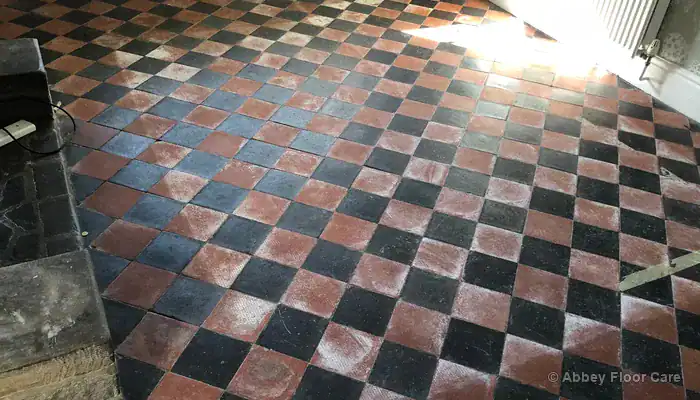
Over time, the voids in the upper clay layers become increasingly filled. The tile darkens from within, and residue cycling begins — each cleaning disrupts surface contamination but fails to reach the deeper layers. The floor becomes slower to absorb new contamination as the upper voids fill, but the existing embedded layer does not diminish without targeted intervention.
The practical implication is that cleaning frequency alone cannot compensate for insufficient cleaning depth. A floor cleaned daily with a general-purpose product may still develop a significant embedded contamination layer over five to ten years. The maintenance routine that prevents this issue involves using correctly formulated pH-neutral cleaning solutions, avoiding detergents that leave their own residues, and removing grit before wet mopping to reduce surface abrasion and contamination issues.
Why do typical cleaning products lose their effectiveness over time?
If your regular floor cleaner worked well for the first year or two but now seems ineffective, it’s likely that the contamination layer has moved beyond the reach of surface-acting products. General-purpose floor cleaners are designed to address residues at or near the surface and are not formulated to penetrate the porous clay body to lift long-standing contamination. Once contamination is embedded, these products merely maintain surface cleanliness without addressing the underlying issues.
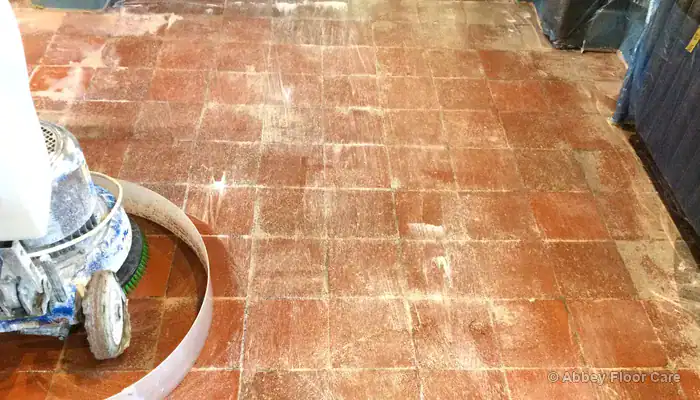
Many household cleaners also leave behind their own residues — surfactants, fragrances, and pH-adjusting agents that the tile absorbs alongside the soil they aim to eliminate. This accelerates the residue cycling process and can result in a surface that feels slightly sticky or appears consistently dull, regardless of recent cleaning. The chemistry required to penetrate the clay body, rather than just the surface, utilises controlled alkaline concentrations, mechanical agitation, and wet extraction — a process that general-purpose products are neither designed nor intended to replicate.
What damage can improper sealing cause to your quarry tile floor?
Applying a film-forming sealer on a moisture-active quarry tile floor does not protect it; instead, it traps the moisture that the floor needs to release. Film-forming products create a physical barrier across the tile’s pores. While they may be suitable for modern glazed tiles, this approach is detrimental for unglazed quarry tiles situated on a moisture-active base, leading to sealer failure, efflorescence, and accelerated deterioration.
Effectively sealing a quarry tile floor involves facilitating moisture movement rather than obstructing it.
The trajectory of breathability failure follows a predictable pattern. Initially, the sealer may seem effective. Within months, moisture vapour accumulating beneath the coating leads to blistering or milky patches. The coating may peel or deteriorate unevenly. Salts from trapped moisture create white crystalline patches on the surface. Homeowners often clean the floor again, frequently applying more product, exacerbating the issue. Throughout this process, the tile remains undamaged; however, restoring proper moisture vapour transmission necessitates professional intervention. An impregnating sealer, which penetrates the tile body instead of resting on top, allows moisture to move while protecting the internal structure from further contamination.
What signs suggest your quarry tile floors are deteriorating?
White powder on the tile surface, inconsistent finishes that return after cleaning, and coatings that peel without clear explanation are interconnected symptoms of the same underlying issue. Each indicates a specific stage of deterioration, and recognising these signs is vital for understanding the floor’s condition.
Efflorescence, the white crystalline or powdery deposit that forms when moisture carries dissolved salts to the surface, signals active moisture movement. This often suggests that something above — whether a surface coating or incompatible sealer — is blocking the evaporation pathway. Homeowners notice a chalky white residue that reappears shortly after cleaning.
Salt migration produces a similar visible effect but occurs deeper within the tile, depositing mineral compounds inside the clay structure rather than on the surface. Over time, this causes the tile surface to appear progressively lighter in affected areas. Sealer failure can be recognised through peeling, mottling, or uneven sheen, signalling areas where the coating has detached from the tile.
What essential maintenance practices help preserve quarry tile floors?
If your quarry tile floor has undergone professional restoration, the following maintenance routine will determine whether it remains in excellent condition or starts to deteriorate within months. The most critical factor is using a pH-neutral cleaner specially formulated for breathable natural tiles — avoiding general-purpose products and any cleaners containing bleach, vinegar, or surfactant residues that the tile may absorb. Choosing the wrong product can reactivate the residue cycling process from the outset.
Equally important is the removal of grit prior to wet mopping. Hard particles of sand and soil tracked indoors act as fine abrasives underfoot, accelerating surface abrasion in the upper clay layer. Dry sweeping or vacuuming before any wet cleaning helps prevent this. Resealing at appropriate intervals, typically every two to three years for an impregnating sealer depending on foot traffic, maintains internal protection without causing surface residue build-up.
When should you consider professional assistance for your floor’s upkeep?
Persistent darkening that does not improve with proper cleaning products, white salts that return soon after removal, and coatings that repeatedly fail indicate that the floor needs professional evaluation instead of continued maintenance.
Utilise the following sequence to assess your floor’s current condition:
- Clean the floor with a properly formulated pH-neutral product and allow it to dry thoroughly. If the darkening returns within 48 hours and the floor appears unchanged after cleaning, the contamination is embedded beneath the surface.
- After removing any visible white deposits, check whether they reappear within a week. Rapid reappearance indicates active moisture movement combined with a blocked or partially obstructed evaporation pathway — this signals a sealer failure condition rather than a cleaning issue.
- Inspect any coatings applied within the last two years. If the coating has begun to peel, mottle, or exhibit an uneven sheen in high-traffic areas, the product was likely incompatible with the floor’s moisture movement profile, necessitating professional removal before further treatment.
What actions should you take based on your floor’s current condition?
Every issue with quarry tiles highlights a specific aspect of the restoration system, and the appropriate starting point depends on the floor’s current condition.
If the floor appears dirty after cleaning and the issue persists, start with the deep cleaning process: deep cleaning quarry tiles to eliminate decades of grime outlines the complete procedure. If the floor shows white deposits, inconsistent finishes, or failing coatings, follow the restoration pathway: quarry tile restoration details the professional remediation process.

David Allen — Abbey Floor Care
With over 30 years of experience, David Allen has specialised in restoring quarry tile floors across the UK, managing a diverse range of projects from Victorian kitchen floors in period homes to heavily contaminated utility rooms that have suffered from decades of improper treatment. His approach to quarry tile work is grounded in a thorough understanding of the clay system — emphasising breathability, moisture movement, and embedded contamination — prior to initiating any cleaning or restoration processes.
The Article Quarry Tile Floors: Why They Darken and How to Restore Breathability first appeared on https://www.abbeyfloorcare.co.uk
The Article Quarry Tile Floors: Restoring Breathability and Brightness appeared first on https://fabritec.org
The Article Restoring Breathability and Brightness to Quarry Tile Floors Was Found On https://limitsofstrategy.com
References:
Restoring Breathability and Brightness to Quarry Tile Floors
https://homerenonews.com.au/restoring-brightness-and-breathability-to-quarry-tile-floors/